
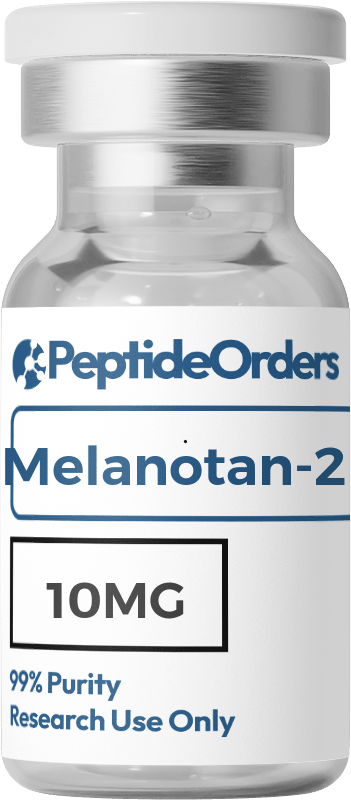
Melanotan-II (MT-II) — Research-Based Peptide Benefits & Scientific Profile
Melanotan-II (MT-II) is a synthetic cyclic heptapeptide analog of alpha-melanocytestimulating hormone (α-MSH) that has been widely used in controlled laboratory and clinical research to study melanocortin receptor biology and its effects on pigmentation, sexual function, appetite regulation, and energy homeostasis. MT-II’s structure and receptor interactions make it valuable in preclinical investigations into melanogenesis and central nervous system pathways.
Scientific & Chemical Identification
- CAS Number: 121062-08-6
- Molecular Formula: C₅₀H₆₉N₁₅O₉
- Molecular Weight (M.W.): ~1024.18 g/mol
- Amino Acid Sequence: Ac-Nle-cyclo[Asp-His-D-Phe-Arg-Trp-Lys]-NH₂
- Synonyms: Melanotan II, MT-II
Peptide Mechanism & Receptor Activity
Melanotan-II acts as a non-selective agonist at melanocortin receptors (MC1R, MC3R, MC4R, and MC5R), mimicking certain effects of endogenous α-MSH in research models. Its cyclic structure, including a lactam bridge, increases stability and affinity compared to natural peptides.
Research-Documented Effects & Benefits
- Enhanced Melanogenesis & Tanning: MT-II activates MC1R in melanocytes, increasing melanin production and resulting in deeper skin pigmentation in experimental settings, with or without UV exposure.
- Sexual Function Activation: Pilot Phase I clinical research showed that subcutaneous MT-II administration can trigger spontaneous erections and sexual arousal responses in normal male volunteers, correlating with central MC4R activation.
- Appetite & Energy Regulation: Agonism of MC3R and MC4R has been explored for appetite suppression and modulation of energy balance in laboratory models.
- Neuroprotective & CNS Pathways: Some preclinical studies suggest that MT-II may engage central melanocortin circuits, affecting cognitive function and mood, although the evidence is early and primarily experimental.
Key Research Studies
- A pilot Phase I clinical trial in healthy male subjects demonstrated MT-II’s superpotent melanotropic activity, with documented autonomic effects, including somnolence, nausea, and spontaneous erections, following controlled dosing.
- Research on melanocortin signal transduction has contributed to a broader understanding of MC receptor activation in pigmentation and sexual arousal mechanisms.